Best hemorrhoids treatment tips, check out our hemorrhoids treatment tips and learn how to remove hemorrhoids, with treatments that can be done at home.

Admit you're wrong and set things right

Genesis
Romans 5: 12-19
Matthew 4: 1-11

We are all tempted to sin, and often we give into these temptations due to pride and selfishness. Then we have a tendency to blame other people for our sins like Adam blamed the woman, and Eve blamed the Serpent.  The only one in the story of Adam and Eve who was honest was the Serpent.  He connived Adam and Eve to commit a sin, and he was proud of his act.

When we do evil things our lives are not as we would like them.  In Matthew (4: 1-11) Jesus is tempted by Satan to do evil things, and he does not give into the temptation.  After fasting for 40 days and 40 nights he is starving, and Satan tries to convince him to create a miracle and make bread, and Jesus tells the Devil to go away.

Paul tells the Romans (Romans 5:12-19) that the sins of one man, or the selfish decisions made by one man, can effect the entire world in a negative way.  One man's decisions can cause havoc on all the rest of society, yet all it takes is one man making an unselfish and honorable decision to set things right.

He writes, "Sin came into the world through one man, and his sin brought death with it.  As a result, death has spread to the whole human race because everyone has sinned.  There was sin in the world before the Law was given; but where there is no law, no account is kept of sins."

He further describes that many people have sinned due to pride and selfish behavior, yet the benefits or gifts or rewards that come from all these sins is never greater than the rewards of the one person who puts himself after other people.  He writes that "one righteous act sets all mankind free and gives them life.  And just as all people were made sinners as the result of the disobedience of one man, in the same way they will all be put right with God as the result of the obedience of the one man."

Of course he was talking about Jesus, yet what he is writing can be symbolic of all mankind.  While we are suffering in this world due to the poor and selfish decisions of only a few men, all it takes is the unselfish works of one man to set things right again.

Likewise, Matthew tells the story (Matthew 4: 1-11) tells how after fasting for 40 days and 40 nights Jesus was starving.  He was tempted by the Devil, who said, "If you are God's Son, order these stones to turn into bread."

Jesus answers, "The Scripture says, 'Man cannot live on bread alone, but needs every word that God speaks."  What he is saying is that good things in life do not come from any material possession including food, good things in life come from virtues.

One of the most simplest of all virtues is to take responsibility for our actions.  We must admit when we sin, and not place blame on other people.  The things that happen to us are not by chance, but the result of our individual choice.  We either choose to have our priorities in the right order, or we do not..

When we have our priorities in the right order, things work right.  When we don't have things in the right order things may work right for a while, yet then they fall apart and getting them back in order can only be accomplished by accepting blame, returning to God (or virtues), and prioritising responsibility.

Lent is a time that we look at our lives and admit that we are sinners, and that we are the cause of our sins.  It is not your wife or your husband that causes you to sin, and it is not Satan, and it is not your mom or dad, it is yourself.  You

Lent is a time when you look at yourself and find what is wrong with your life, and decide to take the wrong out.  Yet to truly accomplish this takes the courage to admit our mistakes, and then to ask God for guidance,  nurturing direction and courage.

Facebook Twitter
read more...

Insights from Dr. Kenneth Hardy

I had the privilege of listening to Ken Hardy as he presented at the NASW CT specialty conference on social justice. He focuses on oppression, which of course has a lot of overlap with trauma.

Dr. Hardy is a Professor of Family Therapy at Drexel University and the Director of the Eikenberg Institute for Relationships in NYC. He has written several books including Teens Who Hurt: Clinical Interventions to break the Cycle of Adolescent Violence (Guilford Press, 2005) and, with Monica McGoldrick, ReVisioning Family Therapy: Race, Culture and Gender in Clinical Practice (Guilford Press, 2008).

Dr. Hardy described people as divided into three groups: jailers, helper, and healer. Jailers value correction over connection. They protect the prevailing order even at the cost of crushing the human spirit. Their primary goal is to keep order, and they use the tactics of demanding obedience or ejection. Their words are: Not here! Out of here! Dr. Hardy pointed out that there is a lot of recruitment and rewards pushing people to become jailers in our current society.

The helper is well intentioned, and tries to intervene in the face of injustice and harm. They try to restore order, but do not focus on preventing injustice from happening. Many of us in the social services world find ourselves in this position.

The healer is a visionary who tries to challenge the established order and to rejuvenate the human spirit. He values connection over discipline. He establishes mutuality. His work is not just a job, it is a passion. He works on behalf of the human condition, to make a better planet. He is in the business of manufacturing hope.

Dr. Hardy suggested that the way to become a healer is by embracing one’s own suffering, turning towards one’s own pain instead of denying it. We have all been oppressed in some way. Look at your own invisible wounds, find and speak your own authentic voice.

In our programs, is there pressure to become jailers? Are we encouraged to become healers?

Shame was a central topic for Dr. Hardy. He spoke that we are even ashamed to admit we feel shame. Shame is a powerful force that cannot be named or spoken about, because it is associated with weakness. Shame arises from the devaluation of human dignity. The more a person’s basic dignity has been eroded and assaulted, the more that person will demand respect, and will be aggressive rather than suffer further degradation.

Further, Dr. Hardy described “learned voicelessness”. This is what happens to a person whose dignity has been degraded, and who has been unable to speak. Of course this applies to children who cannot speak of their abuse. The more a person has been silenced, the stronger their rage. The role of the healer is to help the person find and speak their voice, and transform their rage into outrage that is channeled into action to change the world.

I felt this description illuminated my thinking about effective action: that trauma with its inherent helplessness over time convinces the victim of the impossibility of effective action in their own life. Our job is to re-teach that effective action is possible. Add to that, trauma and its secrecy silencing the voice, and our job is also to help the person regain their voice. We have to be careful that our treatment programs do not themselves demand silence from the clients.

I was very moved by Dr. Hardy’s presentations, and I look forward to reading his books. Stay tuned for book reviews!
read more...

My discussion with a quality assurance analyzer

Quality Assurance Analyzer:  "This patient doesn't meet criteria."

Me:  "So what do you have to do to get him to meet criteria, order breathing treatments?"

QA Analyzer:  "Yes."

Just another example of why RTs get so burned out.

Here's another discussion;

QA Analyzer:  "Did you do any breathing treatments on that kid today?"

Me:  "No."

QA Analyzer:  "Oh!  If you did I could note him as meeting criteria.  Yet otherwise I don't think we can justify the visit."

Me:  "So do you want me to lie and chart that I did one?"

QA Analyzer:  "Yes."  She smiled.

Of course I was joking and I didn't.  Yet this is yet another example of why the government setting criteria is ridiculous. 

Facebook
Twitter
read more...

Things that make our job easier/ harder

It seems to be my first 8 years as an RT saw many new things that made our job better. I'll list some examples here:

1.  Microprocessor ventilators:  work with patient instead of other way around
2.  MicroprocessoBiPAPs:  easy to use, pts tolerate them, and they keep people off vents)
3.  Computer charting:  no longer have to hunt for charts, easy access
4.

However, in the past five years every thing added has made our job harder:

1.  Order sets:  RT procedures automatically ordered even so all bases are covered, increases workload
2.  Protocols called order sets:  increases workload
3.  Medicine locked up:  Inconvenient to get to medicine
4.  Obamacare:  Increased need for QA analyzers and order sets
5.  QA analyzers:  who constantly double check our charting (nit pickers, that's what I call them)
6.

Can you name any more things that have made our jobs easier or harder????

Facebook
Twitter
read more...

The two types of pulmonary edema

Fluid can sometimes build up in the lungs, and we generally refer to this as pulmonary edema.  There are two types of pulmonary edema: 

1.  Caradiogenic:  Fluid backs up from a weakened heart.  Pulmonary pressure increases, and this fluid is forced into the parychemal tissue lining the bronchi and alveoi.

2.  Noncardiogenic:  The heart did not cause the pulmonary edema.  There is a simple pneumonic to remember all the disorders that fit into this category:  NOT CARDIAC.  As noted:
  • Near drowning
  • Oxygen therapy
  • Transfusion or Trauma
  • CNS disorder
  • ARDS, aspiration or altitude sickness
  • Renal disorder or resuscitation
  • Drugs
  • Inhaled toxins
  • Allergic alveolitis
  • Contrast or contusion
Twitter
read more...

No more mist tents

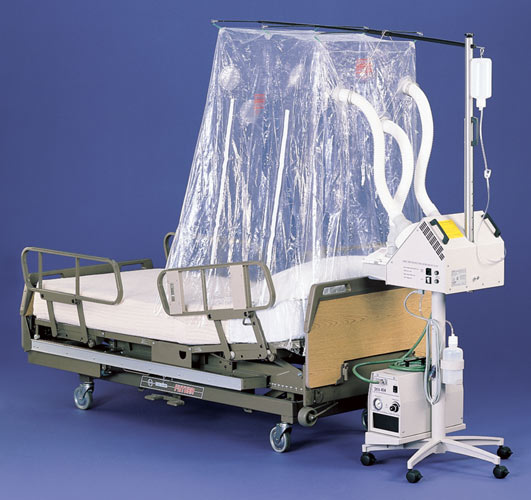
An old mist tent
About five years the infamous RT boss took all the mist tents and put them in the basement of the hospital because there was no room in the RT storage room.  This marked the end of the era of the mist tent for infants.

As a matter of fact, when oxygen was first introduced as a method of inhaling supplemental oxygen in the mid 19th century, the main technique was having the patient sit in a tent.  This was the main technique until the oxygen tank was invented.

During the 1920s oxygen masks and nasal cannulas became the best method of giving oxygen to adults, so tents were left to only a few adults but mainly kids.

Ultimately the tents were cooled by packing ice and water in the back of the device and a cool mist was added to the circulating air inside the tent.  This was one of the main methods of treating kids with inflamed upper air passages, or croup.

When I was 11 in 1981 my doctor wanted to put me in a tent once because I refused to wear a nasal cannula.  The RT was dilly-dallied for hours before complying with the order, yet eventually he talked me into sitting in it.  I remember watching TV through the blurry plastic.  After a few hours in was dinner time and I was allowed out.  I refused to get back in.

Yet even by 1981 using such tents on adults was rare as the grumbling RT implied.  By the time I became an RT in 1995 mist tents, or oxygen tents, were used for this purpose or simply to supply oxygen to kids.

It was to the point that doctors wouldn't even try allowing us to place a nasal cannula on a kid, it was just automatic a mist tent (or oxygen tent) be ordered.  It was our discretion whether we turned on the mist or left it off.  It was on for croup and off for asthma and RSV.  If the doctor had a preference he'd order either mist tent or oxygen tent.

Yet we RTs preferred to use a nasal cannula.  I have rarely met a kid who couldn't tolerate a nasal cannula.  Surely they might fight initially, yet once it's on they forget about it and tolerate it just fine.

The tents posed problems of their own.  For one thing, few kids wanted to stay in one.  Usually to get a kid to stay in the parent would cuddle in the tent-surrounded crib.  This made getting access to the kid difficult.  Plus toys were limited because some could spark and cause fires.

The reason I brought this up was because Advanced for RTs has reported that the CDC no longer recommends mist tents be used because they the mist enhances the spread of droplets in the air.  So this should mark the final farewell to the old and infamous mist tent.

Ironically the CDC has yet to outlaw nebulizers which equally spread droplets into rooms.  I'd like to see the CDC come out and recommend that one way valves or filters be used on all nebulizers, and, if possible, that nebulizers not be used at all unless indicated.

Facebook
Twitter
read more...

Principles

We here a lot in this life that if we as humans live by the principles we set for ourselves that we will grow to be respected people living noble lives.  In this sense we as humans relate principles with good.

It is true that those among us who live under "good" principles tend to lead "good" lives, it is not necessarily true that all principles are all good.  For example, Stalin, Hitler and Mussolini all had certain principles that they followed, and with history as our testament that the principles these evil men followed were not all good.

Although it is true that when a child is born, that child is inherently good.  During the coarse of life he is often faced with prodigious forks in the road where he either can choose the "good" path to nobility and respectability, or he can choose the path to evil.

If you have ever read the Bible, you can look there for many examples.  One is the temptation of Adam and Eve, and another is the temptation of Jesus as described in Matthew (4:1-2): "Then Jesus was led by the Spirit into the desert to be tempted by the devil.  He fasted for forty days and forty nights, and afterwords he was hungry." 

He was starving, and that was when Satan tempted Jesus to turn rock into bread. And Jesus resisted the temptation, stating that the word of God is more valuable than anything on earth, including bread.  So he chose to take the path of goodness. 

Yet the first temptation may not even be mentioned in the Bible.  As is described by Catholic doctrine, Satan was initially created by God as a good angel.  Yet he was faced with a choice, and by his own choice he became evil.  And it is in this same way that many people since that day have decided to take the path of evil.  Although evil for a majority of us may be in a subtle way, it is still evil.

So what is it then is it that drives one to choose one route or the other:  evil or good?  The answer is the principles that we follow for ourselves.  Usually these are laid out for us by our parents, or those who raise us when we are children.  Yet it's actually simpler than that, as the basic principles of life are those of which we are born with:  we are all born inherently good, with the intent of being good.  We become "bad" only by choice.

Thus, the foundation of life is based on the principles we live by.  A principles, as defined by Dictionary.com, is "an accepted or professed rule of action or conduct."  Born as inherently good people with the inalienable right to make free and individual decisions, we, at some point during the early course of our lives, get to decide what principles we will live by.

The principles of good are generally based on virtues such as those that were written by Ben Franklin in his Autobiography:  Temperance (eat not to dullness), Silence (speak not what might benefit you or others), Order (let all you things have their place), Resolution (finish what you start), etc. 

It is my firm belief that most of us yearn to be good, because by being good people we are able to fit into society better.  However, some of us believe the opposite, and Hitler, Stalin and Mussolini are extreme examples of that, and so too is Satan if you be live in that beast.

So the principles most of us follow allow us to keep our natural course in life, and if you're a follower of a Faith, allow you to maintain your purpose in life as directed by God.  Or, by following the basic principles of life, allow you to maximize your ability to use the gifts you were given.

Examples of principles may include:
  1. I will not speak too much, for my words can trap me
  2. I will not take advantage of a drunken woman
  3. I will not sleep with someone until I get married
  4. I will not chart a breathing treatment I did not actually do
  5. I will not let money control my life
  6. I will not eat and drink to fullness or dullness
  7. I will not waste my day away lying around, and instead accomplish something
  8. I will control my anger
  9. I will not complain
  10. I will not disrespect my parents or other people
  11. I will not hold grudges
  12. I will smile as often as I can
  13. I will use only positive words
  14. I will pray often
  15. I will be generous
  16. I will be forgiving
  17. I will treat other people with respect
  18. I will keep my priorities in the right order
Facebook Twitter
read more...
 
© Copyright New Treatment Ways 2011 - All rights reserved.